
Sheila Ojei is a strategist and driver of cross-sector partnerships, with deep expertise in private sector engagement, impact communications, stakeholder engagement, fundraising, and business development. Her work bridges the gap between purpose and performance, helping organisations grow sustainably while delivering measurable impact. She is also the author of The Funding Code: Why Good Work Goes Unfunded and How to Change That.

Sheila currently serves as Director of Philanthropy and Business Development at Plan International Nigeria, where she leads strategic fundraising and resource mobilisation to advance children's rights and achieve gender equality. In this role, she focuses on building transformative partnerships, expanding donor engagement, and mobilising funding to drive lasting social change — including designing the corporate and CSR partnerships that bring private capital into the sector. It's this vantage point — sitting on the side of the table that decides where funding goes, after years spent on the side asking for it, and years before that inside the private sector itself — that shaped the argument at the centre of her book: that funders back alignment, not projects, and that most good work goes unfunded not for lack of merit but for lack of fit.
Before joining Plan International, Sheila was the Country Manager for the African Management Institute (AMI) in Nigeria, where she led the organisation's market entry, drove national growth, and built strategic partnerships to scale access to workplace learning and business development services.
Previously, she served as the Director of Strategy, Partnerships, and Stakeholder Management at the Lagos State Employment Trust Fund (LSETF). There, she led initiatives that supported over 10,000 MSMEs, expanded youth employment, and strengthened the entrepreneurial ecosystem in Lagos State. She pioneered a funding model that leveraged private sector and donor capital while building strategic alliances with local and international development partners.
Earlier in her career, Sheila worked in investment banking and manufacturing — including as Chief Commercial Officer at Covenant Salt Company Limited — gaining hands-on experience in business operations, financial management, and strategic planning from inside the private sector itself. She later transitioned to the tech sector as Head of Communications at Jobberman Nigeria, a leading technology recruitment platform. There, she led brand and communications strategy and oversaw the rollout of the Young Africa Works communications strategy in partnership with the Mastercard Foundation. The initiative aimed to train five million young Nigerians and place three million in dignified work.
Sheila's impact communications and advisory portfolio includes collaborations with UN Women, Shehu Yar'Adua Foundation, Ford Foundation, MacArthur Foundation, Chappal Energies, and others. She specialises in designing high-impact campaigns, funding strategies, and stakeholder engagement plans that unlock capital and drive measurable results.
Beyond her professional achievements, Sheila is also a spoken word artist and creative producer. She has performed on stages including the Nuyorican Poets Café in New York and is the creator of the stage productions Single in Gidi and Still Single in Gidi, both of which premiered at the Lagos Theatre Festival in collaboration with the British Council.
She holds an MBA from Trinity College Dublin, an MA from Regent's University London, and a Bachelor's degree in Accounting from St. John's University, New York.
Sheila brings clarity, creativity, and structure to every project she leads. She is passionate about helping mission-driven organisations scale with purpose, strategy, and sustainability.
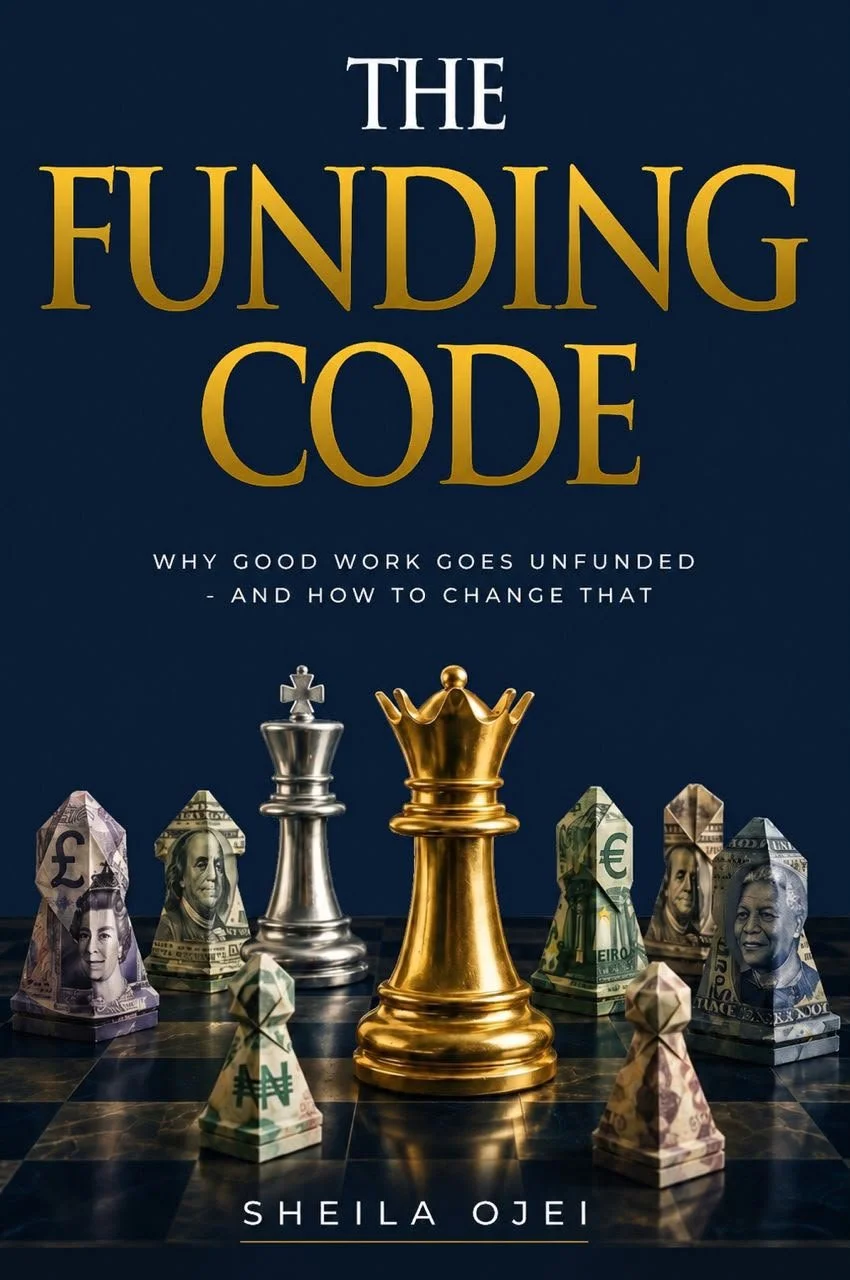
The Funding CodE
Why Good Work Goes Unfunded and How to Change That
Most organisations think they have a funding problem. Sheila argues they have an alignment problem — and shows NGO leaders, social entrepreneurs, and fundraisers across Africa how to close the gap between the work they do and the way funders decide to back it.
Foreword by Olapeju Ibekwe, CEO of Sterling One Foundation